介词 Prepositions
考试:📘 KET ✓ 📙 PET ✓ 📕 FCE·雅思 ✓ 分类:词法 考试入口:KET语法清单 关联:名词与冠词 Nouns & Articles | 动名词与不定式 Gerunds & Infinitives | 比较级与最高级 Comparatives & Superlatives
核心规则(Grammar Core)
时间介词 · in / on / at
| 介词 | 用于 | 例句 |
|---|---|---|
| in | 大时间(月/年/季/世纪/早中晚) | in March, in 2026, in summer, in the morning |
| on | 具体日期/星期 | on Monday, on 25th December, on my birthday |
| at | 精确时刻/节日/特定表达 | at 3 o’clock, at night, at Christmas, at the weekend |
记忆口诀:in 大 on 中 at 小——in 管大范围,on 管中等(天),at 管小时刻。
特殊例外(必须死记):
| 表达 | 介词 | 注意 |
|---|---|---|
| at night | at | 不是 in night ❌ |
| at the weekend | at(🇬🇧)/ on(🇺🇸) | KET 偏英式 → at |
| in the morning/afternoon/evening | in | 但 at night ❌ 不是 in night |
| on Christmas Day | on | 具体日子用 on |
| at Christmas | at | 节日假期用 at |
地点介词 · in / on / at
| 介词 | 用于 | 例句 |
|---|---|---|
| in | 空间内部/城市/国家 | in the box, in London, in China |
| on | 表面上 | on the table, on the wall, on the first floor |
| at | 精确地点/地址 | at the bus stop, at home, at school |
方位介词
| 介词 | 含义 | 例句 |
|---|---|---|
| between | 在……之间(两者) | The shop is between the bank and the post office. |
| among | 在……之间(三者+) | She sat among her friends. |
| next to / beside | 在旁边 | The cat is next to the dog. |
| in front of | 在前面 | He stood in front of the class. |
| behind | 在后面 | The garden is behind the house. |
| opposite | 在对面 | The cafe is opposite the station. |
| above / over | 在上方 | The clock is above the door. |
| below / under | 在下方 | The cat is under the table. |
动词+介词 固定搭配(KET 高频 Top 15)
| 搭配 | 含义 | 例句 |
|---|---|---|
| look at | 看 | Look at this picture! |
| look for | 寻找 | I’m looking for my keys. |
| listen to | 听 | She listens to music every day. |
| wait for | 等待 | We waited for the bus. |
| arrive at/in | 到达 | arrive at the station / arrive in London |
| depend on | 取决于 | It depends on the weather. |
| belong to | 属于 | This book belongs to me. |
| think about/of | 考虑/想起 | I often think about my childhood. |
| agree with | 同意 | I agree with you. |
| apologize for | 道歉 | He apologized for being late. |
| worry about | 担心 | Don’t worry about the exam. |
| interested in | 对……感兴趣 | She’s interested in history. |
| good at | 擅长 | He’s good at maths. |
| different from | 不同于 | English is different from Chinese. |
| famous for | 因……著名 | Paris is famous for the Eiffel Tower. |
动词 + 介词 · 按介词归类记(扩展版 ⭐ Aaron 专项)
别一个一个死背几十个搭配。把每个介词当成一个抽屉——同一个介词管同一类意思,把动词丢进对应的抽屉,就成体系地记住了。⭐ = KET 必背。
抽屉 to(朝向谁 / 对着谁)
| 搭配 | 含义 | 例句 |
|---|---|---|
| listen to ⭐ | 听 | Listen to me! |
| talk / speak to ⭐ | 和……说话 | I talked to the teacher. |
| write to | 写信给 | She wrote to her cousin. |
| belong to ⭐ | 属于 | This pen belongs to Tom. |
| reply to | 回复 | Please reply to my email. |
| get to ⭐ | 到达 | We got to school early. |
抽屉 for(为了 / 找)
| 搭配 | 含义 | 例句 |
|---|---|---|
| wait for ⭐ | 等 | I waited for the bus. |
| look for ⭐ | 寻找 | He’s looking for his cat. |
| ask for ⭐ | 要求 | She asked for help. |
| pay for ⭐ | 付钱买 | Dad paid for the tickets. |
| thank sb for ⭐ | 因……感谢某人 | Thanks for helping me. |
| be late for ⭐ | ……迟到 | Don’t be late for class. |
| be famous for ⭐ | 因……著名 | Paris is famous for the Eiffel Tower. |
| apologize for | 为……道歉 | He apologized for being late. |
抽屉 at(瞄准一个点)
| 搭配 | 含义 | 例句 |
|---|---|---|
| look at ⭐ | 看 | Look at this photo! |
| laugh at | 嘲笑 | Don’t laugh at him. |
| shout at | 对……吼 | She shouted at the dog. |
| arrive at ⭐ | 到达(小地点) | We arrived at the station. |
| be good at ⭐ | 擅长 | He’s good at maths. |
| be surprised at | 对……惊讶 | I was surprised at the news. |
抽屉 about(围绕一个话题)
| 搭配 | 含义 | 例句 |
|---|---|---|
| think about ⭐ | 仔细考虑 | I’m thinking about the trip. |
| talk about ⭐ | 谈论 | They talked about football. |
| worry about ⭐ | 担心 | Don’t worry about the exam. |
| hear about | 听说(某事) | Did you hear about the party? |
| care about | 在乎 | She cares about her friends. |
| be excited about | 对……兴奋 | I’m excited about the holiday. |
抽屉 of(关于 / 由……做成 / 想到)
| 搭配 | 含义 | 例句 |
|---|---|---|
| think of ⭐ | 想起、想到 | I can’t think of his name. |
| be afraid of ⭐ | 害怕 | She’s afraid of spiders. |
| be full of ⭐ | 充满 | The box is full of books. |
| be made of ⭐ | 由……做成 | It’s made of wood. |
| take care of ⭐ | 照顾 | I take care of my sister. |
| be proud of | 为……自豪 | We’re proud of you. |
抽屉 on(依靠 / 接触)
| 搭配 | 含义 | 例句 |
|---|---|---|
| depend on ⭐ | 取决于 | It depends on the weather. |
| put on ⭐ | 穿上 | Put on your coat. |
| turn on ⭐ | 打开(电器) | Turn on the light. |
| get on (with) | 上车 / 相处 | I get on well with my classmates. |
| be keen on | 热衷于 | He’s keen on chess. |
| rely on | 依赖 | You can rely on me. |
抽屉 with(和……一起 / 带着)
| 搭配 | 含义 | 例句 |
|---|---|---|
| agree with ⭐ | 同意(某人) | I agree with you. |
| play with ⭐ | 和……玩 | She plays with her dog. |
| help sb with ⭐ | 帮某人做…… | Can you help me with this? |
| be busy with | 忙于 | He’s busy with homework. |
| be pleased with | 对……满意 | The teacher is pleased with us. |
| be angry with | 生某人的气 | Mum is angry with me. |
抽屉 from(来源 / 分开)
| 搭配 | 含义 | 例句 |
|---|---|---|
| come from ⭐ | 来自 | She comes from Canada. |
| be different from ⭐ | 与……不同 | English is different from Chinese. |
| be far from ⭐ | 离……远 | My house is far from school. |
| borrow … from ⭐ | 向……借 | I borrowed a pen from Tom. |
| hear from | 收到……的消息 | I heard from my grandma. |
| be away from | 远离 | He’s away from home. |
抽屉 in(在领域里 / 参与)
| 搭配 | 含义 | 例句 |
|---|---|---|
| be interested in ⭐ | 对……感兴趣 | She’s interested in history. |
| take part in ⭐ | 参加 | We took part in the game. |
| arrive in ⭐ | 到达(大地点) | They arrived in London. |
| live in ⭐ | 住在 | I live in a small town. |
| believe in | 信仰、相信 | I believe in myself. |
| succeed in | 成功做…… | He succeeded in passing. |
同一个动词换介词 = 换意思(放射星图): think about sth(仔细考虑某事)/ think of sth(想起、想到某事) good at(擅长)/ good for(对……有益)/ good with(善于应对,good with kids) hear about(听说某事)/ hear from(收到某人消息)/ hear of(听说过某人某物)
介词 + 短语 · 固定组合速查(完形填空高频块)⭐
这些是整块记的”乐高积木”,不要拆开一个字一个字想。KET 完形(Open Cloze)最爱在这里挖空。
时间块 in time(及时)· on time(准时)· at first(起初)· at last(终于)· in the end(最后)· at the moment(此刻)· for a while(一会儿)· at once(立刻)· in a hurry(匆忙)· from time to time(偶尔)
as 家族(Aaron 易错 ⚠️)
as soon as possible(尽快)· as soon as(一……就)· as … as(和……一样)· as well(也)· as usual(照常)
礼貌 / 情感块 That’s (very) kind / nice of you(你真好)· Thanks for + V-ing(谢谢你做……)· Thank you for + 名词 · be sorry for · It’s nice to meet you
Aaron 真题错点复盘(2026-05)
错题 1:
Let me know as soon ___ possible.❌ Aaron 填了 in → ✅ 正确是 as。as soon as possible是一块锁死的积木——两头都是 as,中间 soon 不动。直接记成一个词 “ASAP”。错题 2:
I finish school a bit later ___ you.❌ Aaron 填了 after than → ✅ 正确是 than。 这里 later 是比较级(late → later),比较级后面永远跟 than(“比……“)。一个空只填一个词,than 本身已含”比”的意思,不要再加 after。 👉 比较级口诀:-er / more + than(bigger than / later than / more interesting than)。详见 比较级与最高级 Comparatives & Superlatives。
Grammar Lens
🌐 in / on / at · 时间 ↔ 地点 平行结构
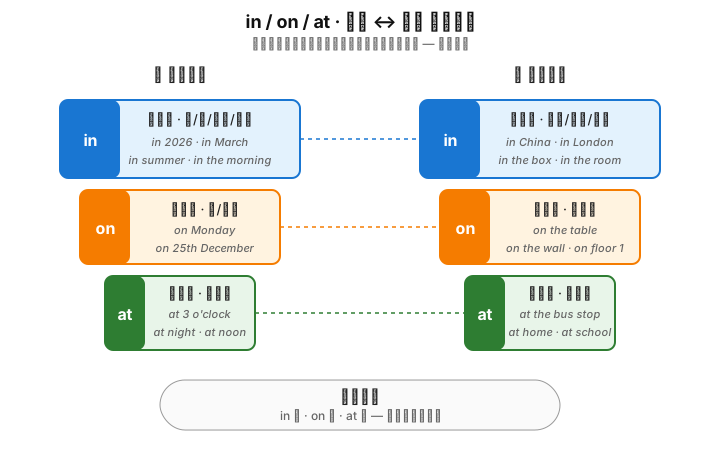
关键洞察:英语用同样的三个介词管时间和地点——in 大、on 中、at 小。背的时候两边一起背,记一对就有两个用法。
🌟 动词 + 介词 · 放射星图
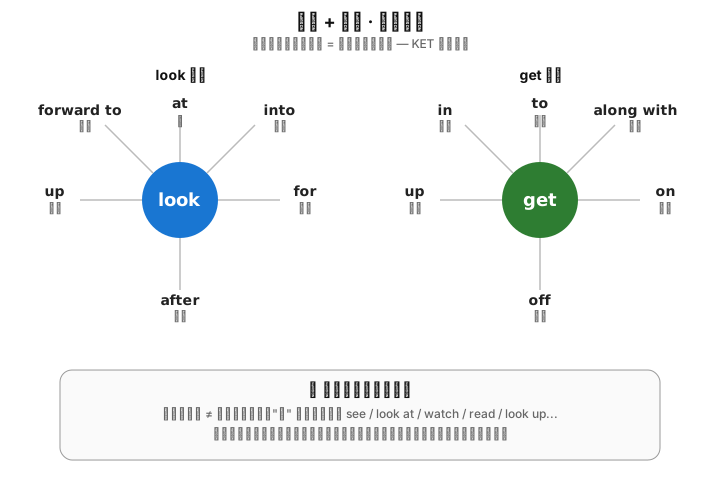
怎么用:每学一个新动词,就在脑中给它画一张星图——同一动词搭不同介词意思完全不同。look at(看)/ look for(找)/ look after(照顾)/ look up(查)—— 在中文里是四个不同的字,在英语里只是 look 后面跟谁。
到达:arrive at vs arrive in vs get to vs reach
| 表达 | 用于 | 例句 |
|---|---|---|
| arrive at | 小地点 | arrive at the airport |
| arrive in | 大地点 | arrive in New York |
| get to | 通用 | get to school / get to the city |
| reach | 直接跟名词(无介词) | reach the top of the mountain |
Trap ❌
arrive to— arrive 后面永远是 at 或 in,不是 toreach to— reach 直接跟名词,不加 to
by + 交通工具(不加冠词)
by bus / by train / by car / by plane / by bike
但:on foot(步行)
by the bus❌ /by a car❌ — by + 交通工具之间没有冠词。
⚠️ to 的双重身份 — Aaron 最容易犯晕的地方
英语里有两个长得一模一样的 to,身份却完全不同。分不清它俩,就会在 want to / plan to / look forward to 之间犯晕。
| 🅰️ 不定式 to(动词的”小尾巴”) | 🅱️ 介词 to(真正的介词) | |
|---|---|---|
| 后面跟什么 | 动词原形(do / go / see / bring) | 名词 / 代词 / V-ing(school / me / seeing) |
| 怎么看出来 | to 后面是”一个动作的原形” | to 后面是”一样东西 / 一个人 / 一个 -ing” |
| 例子 | want to go · plan to visit · need to bring · hope to see · ‘d like to leave · decide to stay · learn to swim · try to finish · forget to lock · promise to call | listen to music · go to school · belong to me · talk to her · look forward to seeing you · be used to getting up early |
一句话记牢:想做 / 打算做 / 需要做 / 希望做 / 答应做 → 后面一律 to + 动词原形。
回到 Aaron 的真题(图2)——这三个 to 全是不定式,后面全跟动词原形,Aaron 全做对了,要保持这个手感:
Do you want to come?               → want + to come ✅
Dad would like to leave at 4.      → would like + to leave ✅
Is there anything I need to bring? → need + to bring ✅
唯一要小心的”假朋友”:少数词组里的 to 是介词,后面要用 V-ing 不是原形——最高频的就是 look forward to:
✅ I look forward to seeing you.   (to 是介词 → seeing)
❌ I look forward to see you.
✅ I want to see you.              (to 是不定式 → see)
想系统搞懂”动词后面到底接 to-do 还是 V-ing”,进阶到 📙 PET 时看 动名词与不定式 Gerunds & Infinitives。
😂 Grammar Joke
介词的噩梦
An English teacher wrote on the board: “A woman without her man is nothing.”
She asked the boys to add punctuation. They wrote: “A woman, without her man, is nothing.”
Then she asked the girls. They wrote: “A woman: without her, man is nothing.”
同一个句子,标点不同,意思完全相反。 男生版:女人没有男人就什么都不是。 女生版:没有女人,男人什么都不是。
语法点:介词 without 的宾语不同,句意完全改变。without her man(没有她的男人)vs without her(没有她)。英语中介词 + 代词的搭配决定了”谁对谁做了什么”——一个词的位置就能翻转整个句子的权力关系。
🏛 语言文化光点
英语介词为什么这么难?因为每种语言”看空间”的方式不同
中文说”在桌子上”,英语说 “on the table”——这里刚好对应。但中文说”在墙上”,英语说 “on the wall”(和桌子一样用 on)。中文说”在天花板上”,英语却说 “on the ceiling”——英语觉得天花板也是一个”表面”。
中文说”坐在公共汽车上”,英语说 “on the bus”——因为英语把公交车当成一个平台(你站在上面)。但出租车用 “in a taxi”——因为出租车小,你是被包在里面的。
on the bus / on the train / on the plane(大型交通工具 = 平台) in a taxi / in a car(小型交通工具 = 包裹)
没有逻辑,只有英国人怎么看世界。多读书虫,多遇到,就记住了。
例题精讲
例1(📘 KET · 时间介词 Reading Part 2)
The meeting is _____ Monday _____ 3 o’clock _____ the afternoon.
答案:on Monday, at 3 o’clock, in the afternoon。
例2(📘 KET · 地点介词)
The supermarket is _____ the bank and the post office.
答案:between。两者之间 → between。
例3(📘 KET · 动词+介词)
She is very good _____ playing the piano.
答案:at。good at = 擅长。
例4(📙 PET · arrive 辨析)
We arrived _____ the hotel late _____ night.
答案:at the hotel(小地点),at night(固定搭配)。
例5(📙 PET · 介词综合段落)
I live in a small town in the south of England. My house is on a quiet street, next to a park. Every morning, I walk to school. It takes about 15 minutes on foot. I usually arrive at school at 8:30.
一个段落里用了7个介词——这就是 PET 阅读的真实密度。
例6(📘 KET · 邮件完形 Open Cloze · 综合 Aaron 痛点)
Hi Leo, Thanks (1) _____ inviting me to your party! I’d love (2) _____ come. I asked Mum and she said yes. I’ll get (3) _____ your house at 6 o’clock. Is there anything I need (4) _____ bring? Please let me know (5) _____ soon as possible. See you!
| 空 | 答案 | 为什么 |
|---|---|---|
| (1) | for | thank sb for + V-ing(介词 for + inviting) |
| (2) | to | ’d love to come(不定式 to + 原形) |
| (3) | to | get to your house(介词 to,到达某地) |
| (4) | to | need to bring(不定式 to + 原形) |
| (5) | as | as soon as possible(固定块) |
一道题集齐 Aaron 全部痛点:介词 for / 不定式 to / 介词 to / 不定式 to / 固定块 as。看懂这道,完形里的动词搭配就过关了。
📖 Real English · 真实阅读
🔵 A Postcard from London
Dear Aaron,
I arrived in London on Monday. I’m staying at a small hotel near the Thames. On the first day, I went to the Tower of London. It was built in 1066. I stood in front of the Crown Jewels for twenty minutes — they were amazing! In the afternoon, I walked across Tower Bridge and took photos from the middle. At night, I had fish and chips at a pub beside the river. Tomorrow I’m going to Buckingham Palace. The Changing of the Guard starts at 11 a.m. I’ll be there before 10 to get a good spot. Wish you were here!
🔵 The International Space Station
The International Space Station (ISS) flies around the Earth at a speed of 28,000 km/h. It orbits the planet once every 90 minutes. Astronauts live on the station for about six months. They sleep in small cabins and eat food from special packages. In space, there is no “up” or “down,” so astronauts can sleep on the ceiling if they want. They exercise for two hours every day on special machines to keep their muscles strong. At night — which comes every 45 minutes — they close the window covers and try to sleep. The ISS has been in orbit since 1998.
🔵 Finding Your Way in Tokyo
Getting around Tokyo is easy if you know the system. Most tourists travel by train. The subway map looks confusing at first, but it is actually very logical. Each line has a colour: the Ginza Line is in orange, the Marunouchi Line is in red. You buy tickets at machines near the entrance. Trains arrive on time — usually within 30 seconds of the schedule. In the morning, trains between 7:30 and 9:00 are extremely crowded. At some stations, staff push passengers into the carriages. If you get lost, look for signs in English — most stations have them above the platforms.
📝 中文注释(先读完英文再展开)
伦敦明信片:in London/on Monday/at a hotel/near the Thames/in 1066/in front of/for twenty minutes/in the afternoon/across/from/at night/at a pub/beside/to/at 11 a.m./before 10——一张明信片里几乎所有常见介词都出场了。注意 arrive in London(大地点用 in)。
国际空间站:around/at a speed of/on the station/for six months/in small cabins/from packages/in space/on the ceiling/for two hours/on machines/at night/in orbit/since 1998。注意 since 1998 搭配完成时(has been),for six months 表一段时间。
东京地铁指南:by train(零冠词)/at first/in orange/at machines/near the entrance/on time/within 30 seconds/in the morning/between 7:30 and 9:00/at some stations/into the carriages/for signs/in English/above the platforms。交通指南是介词的高密度场景。
练习题
📘 KET 基础(5题)
- I was born _____ 15th July _____ 2014.
- There’s a picture _____ the wall.
- She goes to school _____ bus.
- I’ll meet you _____ the cinema _____ 7 p.m.
- He’s been waiting _____ you for twenty minutes.
📙 PET 进阶(3题)
- 填空:She apologized _____ forgetting my birthday and promised to make it up _____ me.
- 选择:We arrived _____ Paris late in the evening. (A. at B. in C. to)
- 用5个不同介词写一段描述你房间位置和里面物品的短文。
📘 KET 完形实战 · 邮件填空(仿真题 · 每空填一个词)
Hi Sam, My dad has got two tickets (1) _____ the football match on Saturday. My brother isn’t free, so do you want (2) _____ come? We plan (3) _____ leave home at 3 o’clock. It’s not far — we can get there (4) _____ bus. Let me know (5) _____ soon as you can!
答案 + 解析(先自己填完再展开)
(1) for — tickets for the match(for 表”为了……的票”) (2) to — want to come(不定式 to + 动词原形) (3) to — plan to leave(不定式 to + 动词原形) (4) by — by bus(by + 交通工具,零冠词,不加 the/a) (5) as — as soon as you can(as 家族固定块)
🗣 日常习惯用语 · 读背清单(Aaron 专项)
怎么用这份清单:每天大声读 1 组,读到顺口为止——这些是英语的”乐高积木”,整块吞,不要拆成单词逐字翻译。背熟后写邮件、说口语会自动从嘴里蹦出来,完形填空遇到也能秒认。✅ 标星的是 KET 邮件/口语最高频。
1️⃣ 打招呼 & 开场(Greetings)
| 英文 | 中文 |
|---|---|
| How’s it going? ✅ | 最近怎么样? |
| How are you doing? | 你好吗? |
| Long time no see. | 好久不见。 |
| Nice to meet you. ✅ | 很高兴认识你。 |
| Nice to see you again. | 很高兴又见到你。 |
| What’s up? | 怎么了 / 最近忙啥? |
2️⃣ 邮件 / 短信常用(Email — 完形高频战场)✅
| 英文 | 中文 |
|---|---|
| Thanks for your email. ✅ | 谢谢你的邮件。 |
| Thanks for inviting me. ✅ | 谢谢你邀请我。 |
| I’d love to come. ✅ | 我很乐意来。 |
| Let me know as soon as possible. ✅ | 请尽快告诉我。 |
| Let me know if you can come. ✅ | 你能来就告诉我一声。 |
| Looking forward to seeing you. ✅ | 期待见到你。 |
| See you soon / See you on Saturday. ✅ | 回头见 / 周六见。 |
| Write back soon. | 尽快回信。 |
| Hope to hear from you. | 希望收到你的回信。 |
3️⃣ 表态:同意 / 拒绝 / 感谢 / 道歉(Reactions)✅
| 英文 | 中文 |
|---|---|
| That’s a good idea. ✅ | 好主意。 |
| That’s really kind of you. ✅ | 你真是太好了。 |
| Sounds good! / Sounds great! ✅ | 听起来不错! |
| No problem. ✅ | 没问题。 |
| Of course. / Sure. ✅ | 当然可以。 |
| I’m afraid I can’t. ✅ | 恐怕我不行。 |
| I’m sorry for being late. ✅ | 抱歉我迟到了。 |
| Don’t worry about it. ✅ | 别担心。 |
| Never mind. | 没关系。 |
| It doesn’t matter. | 没关系 / 无所谓。 |
4️⃣ 时间 & 约定(Time & Arranging)✅
| 英文 | 中文 |
|---|---|
| What time shall we meet? ✅ | 我们几点见? |
| Let’s meet at 4 o’clock. ✅ | 我们四点见吧。 |
| in time / on time ✅ | 及时 / 准时 |
| at first … in the end ✅ | 起初…… 最后…… |
| at the moment | 此刻 / 目前 |
| for a while | 一会儿 |
| from time to time | 偶尔 |
| right now / right away | 现在就 / 马上 |
5️⃣ 指路 & 方位(Directions — 听力地图题)
| 英文 | 中文 |
|---|---|
| Go straight on. | 一直往前走。 |
| Turn left / right at the corner. | 在拐角左转 / 右转。 |
| It’s next to the bank. | 在银行旁边。 |
| It’s opposite the station. | 在车站对面。 |
| It’s on your left / right. | 在你左手边 / 右手边。 |
| It’s between the shop and the café. | 在商店和咖啡馆之间。 |
6️⃣ 口语小词块(Speaking)
| 英文 | 中文 |
|---|---|
| Can you say that again, please? | 能再说一遍吗? |
| I’m not sure. | 我不确定。 |
| Let me think. | 让我想想。 |
| Me too. / Me neither. | 我也是。/ 我也不。 |
| By the way … | 顺便说一句…… |
| In my opinion … | 在我看来…… |
背诵节奏建议:每天 1 组(约 6–10 条),早读一遍、睡前再读一遍,一周轮完六组,第二周打乱重背。会读会背之后,挑 2 条写进当天的英文小作文或对话——用过一次,才算真正变成自己的。
🔗 节点关系
介词 ──────────┬─ 时间介词(in/on/at + 时间信号词 → 时态判断)
               ├─ 地点介词(KET 阅读/听力地图题)
               ├─ 动词+介词搭配(按介词归类:to/for/at/about/of/on/with/from/in)
               ├─ ⚠️ to 双重身份(不定式 to+原形 vs 介词 to+名词/V-ing)
               ├─ 介词+短语固定块(as soon as possible / in time / kind of you)
               ├─ 日常习惯用语(邮件/口语高频,读背批量)
               └─ by + 交通工具(零冠词规则 → 名词与冠词)
双链跳转: 名词与冠词 Nouns & Articles | 动名词与不定式 Gerunds & Infinitives | 比较级与最高级 Comparatives & Superlatives | 现在完成时 Present Perfect | There Be 存在句
🔗 高频枢纽词 词枢纽 →
以下词汇属于 K12 词枢纽,在本节点高频出现——点击可查看同义辨析与 Aaron 易错点。