现在完成时 Present Perfect
考试:📘 KET ✓ 📙 PET ✓ 📕 FCE·雅思 ✓ 分类:时态 考试入口:KET语法清单 关联:一般过去时 Simple Past(易混淆⚠️⚠️⚠️)| 一般现在时 Simple Present
核心规则(Grammar Core)
什么时候用?
现在完成时是连接过去和现在的桥梁:
- 经历 — I have visited London three times.(到目前为止的人生经历)
- 持续 — She has lived here for ten years.(从过去持续到现在)
- 刚完成,影响现在 — I have lost my key.(所以现在进不了门)
- 变化 — He has grown much taller.(过去矮,现在高了)
构成公式
| 句型 | 公式 | 例句 |
|---|---|---|
| 肯定 | S + have/has + V过去分词(pp) | They have finished the project. |
| She has visited London twice. | ||
| 否定 | S + have/has + not + pp | I haven’t seen that film. |
| He hasn’t called me yet. | ||
| 疑问 | Have/Has + S + pp? | Have you ever been to Paris? |
| Has she finished her homework? |
have → 用于 I / you / we / they has → 用于 he / she / it
过去分词(Past Participle)
- 规则动词:和过去式一样加 -ed(played, visited, watched)
- 不规则动词:需要单独记(go→gone, see→seen, eat→eaten)
高频不规则过去分词(和过去式不同的):
| 原形 | 过去式 | 过去分词 | 记忆 |
|---|---|---|---|
| go | went | gone | 三个全不同 |
| see | saw | seen | -n 结尾 |
| eat | ate | eaten | -en 结尾 |
| take | took | taken | -en 结尾 |
| give | gave | given | -en 结尾 |
| write | wrote | written | 双 t + -en |
| do | did | done | 完全变 |
| be | was/were | been | 完全变 |
Grammar Lens
时间轴定位
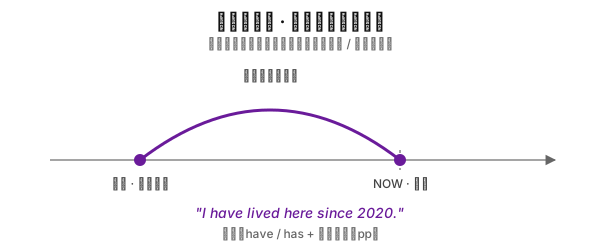
一般过去时是一张旧照片(定格在过去);现在完成时是一条从过去拉到现在的线。
对比辨析:完成时 vs 过去时 ⚠️⚠️⚠️(考试第一高频)
| 现在完成时 | 一般过去时 |
|---|---|
| 不说具体过去时间 | 有明确过去时间 |
| I have been to Japan. | I went to Japan in 2023. |
| 关注结果/经历 | 关注过去那个时刻 |
| Have you eaten lunch? | Did you eat lunch? |
黄金法则:
| 看到这些词 → 用完成时 | 看到这些词 → 用过去时 |
|---|---|
| already, yet, just | yesterday, last week |
| ever, never | ago, in 2023 |
| for, since | when I was young |
| so far, up to now | at that time, then |
have been vs have gone ⚠️
| 含义 | 例句 | |
|---|---|---|
| have/has been to | 去过(已经回来了) | I have been to London.(去过,回来了) |
| have/has gone to | 去了(还没回来) | He has gone to London.(人在伦敦) |
KET 经典陷阱:
— Where’s Tom? — He has gone to the library.(他去了图书馆 = 人不在这里)
He has been to the library.(这表示他去过图书馆但已经回来了——和 “Where’s Tom” 矛盾)
for vs since(📙 PET 深化,📘 KET 只需识别)
📘 KET 层:只需要认识 for/since,能在阅读中理解含义即可。 📙 PET 层:必须熟练区分并在写作中正确使用。
| for + 一段时间 | since + 起点时间 |
|---|---|
| for three years | since 2023 |
| for two hours | since 9 o’clock |
| for a long time | since I was a child |
| for ages | since last Monday |
一句话区分:for 回答 “how long”(多长时间),since 回答 “when”(从什么时候开始)。
😂 Grammar Joke
have been vs have gone
Teacher: “Where is your homework?” Student: “It has gone to a better place.” Teacher: “You mean you threw it away?” Student: “No, teacher. It has been to many places — my dog’s mouth, the toilet, and finally the bin.” Teacher: “So it has gone and it isn’t coming back?” Student: “It has been a difficult journey for all of us.”
老师问作业在哪。学生说作业”去了一个更好的地方”(has gone = 去了没回来)。 老师追问,学生说作业”去过很多地方”(has been = 去过又回来了)——狗嘴里、马桶里、最后到了垃圾桶。
语法点:has gone to(去了,没回来)vs has been to(去过,回来了)——即使是一份作业,这个区别也很重要。
🏛 语言文化光点
“I have a dream” 为什么不是完成时?
马丁·路德·金(Martin Luther King Jr.)1963年的演讲名句 “I have a dream” 里的 have 是”拥有”,不是完成时的助动词。
但他后面说的 “I have been to the mountaintop”(我曾到达山顶)就是完成时——表达人生经历,不指定具体时间。
在英语里,have 身兼两职:既是”拥有”的实义动词,又是完成时的助动词。区分方法:have 后面跟的是名词(拥有)还是过去分词(完成时)。
例题精讲
例1(📘 KET · 完成时 vs 过去时)
— _____ you ever _____ (try) Japanese food? — Yes, I _____ (eat) sushi when I _____ (be) in Tokyo last year.
答案:Have you ever tried(经历 → 完成时);ate, was(last year = 具体时间 → 过去时)。
例2(📘 KET · been vs gone)
— Where’s your sister? — She _____ (go) to the supermarket. She’ll be back in an hour.
答案:has gone。她人不在这里 → has gone to。
例3(📘 KET · for vs since)
I have known him _____ we were in primary school. I have known him _____ ten years.
答案:since(起点);for(一段时间)。
例4(📙 PET · Writing Part 1 句型转换)
She started learning piano five years ago. She _____ _____ _____ piano for five years.
答案:has been learning 或 has learned/learnt。started…ago → has…for 是 PET 黄金转换公式。
例5(📙 PET · 复合场景)
“I have visited ten countries so far. Last summer, I went to Iceland. It was amazing — I saw the Northern Lights! I have never seen anything so beautiful in my life.”
注意完成时和过去时在同一段话中的自然切换:总结经历用完成时,讲具体故事用过去时。
例6(📕 FCE · 高级用法)
This is the best book I have ever read. It’s the first time I have been to a classical concert.
“the best/worst/first… + 完成时” 是固定搭配。FCE/雅思写作高频句式。
📖 Real English · 真实阅读
🔵 Record Breakers
Usain Bolt has broken the world record for the 100-metre sprint three times. He first set the record in 2008, and his final record of 9.58 seconds has stood since 2009. No one has beaten it yet. Meanwhile, Simone Biles has won more World Championship medals than any other gymnast in history. She has competed in three Olympic Games. “I have worked my whole life for this,” she said after winning gold in Paris.
🔵 How Technology Has Changed Our Lives
Think about how much life has changed in just 20 years. In 2005, most people had never heard of a smartphone. Today, over 6 billion people have one. Social media has connected people across the world, but it has also created new problems like cyberbullying. Streaming services have replaced DVDs. AI has begun to write, draw, and even compose music. Your parents grew up without the internet — you have never known a world without it.
🔵 An Explorer’s Journal
I have travelled to 47 countries so far. Last year, I went to Antarctica — it was the coldest place I have ever been to. I saw penguins walking on the ice, and I took hundreds of photos. I have always wanted to visit every continent, and now I have done it — all seven! Next, I am going to try something different. I have never climbed a mountain higher than 5,000 metres. Everest is waiting.
📝 中文注释(先读完英文再展开)
纪录打破者:博尔特三次打破百米世界纪录,9.58秒的纪录自2009年至今无人打破(has stood/has beaten — 完成时表示”到现在为止”)。拜尔斯赢得最多世锦赛奖牌(has won/has competed)。注意 “He first set the record in 2008” 用过去时——有具体时间。
科技如何改变生活:20年间生活巨变——has changed/has connected/has created/have replaced/has begun 用完成时总结”到目前为止的变化”。“Your parents grew up without…” 用过去时,“you have never known…” 用完成时——过去时 vs 完成时的自然切换。
探险家日记:去过47个国家(have travelled),去年去了南极(went — 过去时,有具体时间 last year),是去过最冷的地方(have ever been — 完成时谈经历),想爬珠峰(have never climbed — 从未做过)。这段是完成时和过去时混用的完美示范。
练习题
📘 KET 基础(8题)
A 组 · just / already / yet / ever / never(📘 核心)
- I _____ already _____ (finish) my homework. Can I go out?
- _____ you ever _____ (be) to America?
- He _____ not _____ (call) me yet.
- She has _____ (just / arrive). She’s still at the door.
- I have _____ (never / try) Indian food.
B 组 · been to vs gone to(📘 高频陷阱)
- — Where’s Dad? — He _____ (go) to the office.(人不在家)
- — Have you ever _____ (be) to Japan? — Yes, I went last year.
- Tom isn’t here. He has _____ (go/be) to the library. Lily has _____ (go/be) to the library too, but she’s back now.
📙 PET 进阶(3题)
- 句型转换:I last saw her two weeks ago. → I _____ _____ _____ her for two weeks.
- 选择:This is the most interesting film I _____ (ever / see).
- 混合段落填空(完成时 + 过去时): I (1)_____ (travel) to many places. Last year, I (2)_____ (go) to Greece. I (3)_____ (stay) there for two weeks. It is the most beautiful country I (4)_____ ever _____ (visit).
🔗 节点关系
一般过去时(易混⚠️⚠️⚠️ 过去 vs 到现在)
    ↕
现在完成时 ──────┬─ 现在完成进行时(have been doing · PET)
                 ├─ 过去完成时(过去的过去 · PET)
                 └─ for/since → 持续状态
双链跳转: 一般过去时 Simple Past | 一般现在时 Simple Present | 介词 Prepositions
🔗 高频枢纽词 词枢纽 →
以下词汇属于 K12 词枢纽,在本节点高频出现——点击可查看同义辨析与 Aaron 易错点。