疑问句 Questions
考试:📘 KET ✓ 📙 PET ✓ 分类:句型结构 考试入口:KET语法清单 关联:五大基本句型 Five Sentence Patterns | 一般现在时 Simple Present | 一般过去时 Simple Past
核心规则(Grammar Core)
一般疑问句(Yes/No Questions)
把助动词/be 动词提到主语前面:
| 陈述句 | 疑问句 |
|---|---|
| You are a student. | Are you a student? |
| She can swim. | Can she swim? |
| They like music. | Do they like music? |
| He went to London. | Did he go to London? |
没有 be/情态动词时 → 借助 do/does/did
特殊疑问句(Wh- Questions)
疑问词 + 助动词 + 主语 + 动词原形?
| 疑问词 | 问什么 | 例句 |
|---|---|---|
| What | 什么 | What do you do?(你做什么工作?) |
| Where | 哪里 | Where does she live? |
| When | 什么时候 | When did you arrive? |
| Who | 谁 | Who is your best friend? |
| Why | 为什么 | Why are you late? |
| How | 怎样 | How do you get to school? |
| Which | 哪一个 | Which colour do you prefer? |
| Whose | 谁的 | Whose bag is this? |
How 的家族(KET 高频)
| 表达 | 问什么 | 例句 |
|---|---|---|
| How old | 年龄 | How old are you? |
| How much | 价格/数量(不可数) | How much is this shirt? / How much water? |
| How many | 数量(可数) | How many students are there? |
| How long | 多长时间/距离 | How long does it take? |
| How far | 多远 | How far is it from here? |
| How often | 频率 | How often do you exercise? |
| How tall/high | 多高 | How tall are you? |
疑问词做主语时——不加助动词!⚠️
普通疑问句:What did you see?(你看到了什么?→ 问宾语)
                    ↑ 需要 did

主语疑问句:Who saw the accident?(谁看到了事故?→ 问主语)
              ↑ 不需要 did!直接 Who + 动词
| 问宾语(需要助动词) | 问主语(不需要助动词) |
|---|---|
| Who did you call? | Who called you? |
| What did she buy? | What happened? |
Grammar Lens
KET 听力的疑问句密码
KET 听力对话几乎全靠疑问句推动。听到疑问词,立刻预判答案类型:
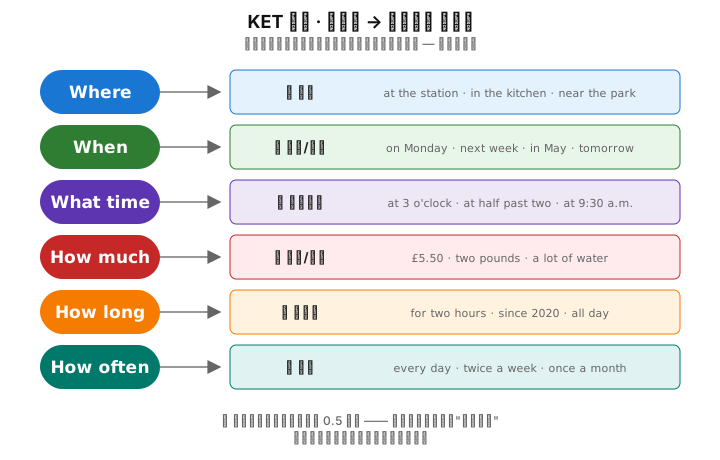
这个”预判→锁定”的习惯能让 KET 听力正确率大幅提升 —— 听到疑问词的 0.5 秒内,大脑就要锁定答案”长什么样”。即使只听懂半句,也能从答案类型反推。
反意疑问句(Tag Questions · 📙 PET)
肯定句 + 否定tag:You like coffee, don't you?
否定句 + 肯定tag:She can't swim, can she?
规则:前肯后否,前否后肯。tag 用和前句相同的助动词/be动词。
😂 Grammar Joke
How 家族的报复
Teacher: “How many letters are there in ‘the alphabet’?” Student: “Three. T-H-E.” Teacher: “No, I mean how many letters in THE ALPHABET?” Student: “Oh! 11. T-H-E-A-L-P-H-A-B-E-T.” Teacher: “There are 26 letters in the alphabet!” Student: “Well, you didn’t ask how many letters in ‘A to Z’. You asked how many in ‘the alphabet’.”
老师问 “the alphabet”(字母表)里有多少字母,学生按字面意思数了 “the alphabet” 这个短语里有几个字母。
语法点:How many + 可数名词复数 是 KET 听力的核心句式。这个笑话说明了英语中”精确提问”的重要性——同一个 How many 问题,因为宾语不同,答案完全不同。
🏛 语言文化光点
英国人用问句表达一切
英国文化有一个特点:用疑问句表达不是疑问的意思。
“Isn’t it a lovely day?” = 今天天气真好。(不是真的在问) “Would you mind closing the door?” = 请关门。(不是真的在问你介不介意) “Could you possibly help me?” = 请帮我一下。(不是在质疑你的能力)
这种”把命令/陈述包装成问句”的习惯,是英式礼貌(British politeness)的核心。书虫里的英国角色几乎从不直接命令人——他们总是用问句。
例题精讲
例1(📘 KET · 疑问词选择)
— _____ do you go to school? — By bus.
答案:How。问方式/交通工具 → How。
例2(📘 KET · How 家族)
— _____ does it take to get to the airport? — About 30 minutes.
答案:How long。问时间长度 → How long。
例3(📘 KET · 主语疑问句)
— _____ broke the window? — Tom did.
答案:Who。问主语 → Who + 动词(不加 did)。
例4(📘 KET · do/does/did 助动词)
— _____ your sister _____ (like) chocolate? — Yes, she loves it.
答案:Does your sister like。第三人称单数 → does + 原形。
例5(📙 PET · 反意疑问句)
You’ve been to London, _____ _____?
答案:haven’t you。前面肯定(have been)→ 后面否定 haven’t。
📖 Real English · 真实阅读
🔵 An Interview with a Young Inventor
Reporter: How old are you, Emma? Emma: I’m fourteen. Reporter: What did you invent? Emma: A water filter made from recycled plastic. Reporter: Why did you decide to make it? Emma: Because many children in the world don’t have clean water. I wanted to help. Reporter: How long did it take you to build it? Emma: About six months. Reporter: Who helped you? Emma: My science teacher gave me advice, but I did most of the work myself. Reporter: How many filters have you made so far? Emma: Over 200. Aren’t they amazing? Reporter: They certainly are. What are you going to do next? Emma: I’m going to send them to schools in Africa.
🔵 20 Questions: Can You Guess the Animal?
This is a classic game. One person thinks of an animal. The others ask yes/no questions:
“Is it bigger than a dog?” — Yes. “Does it live in water?” — No. “Can it fly?” — No. “Does it eat meat?” — Yes. “Is it found in Africa?” — Yes. “Has it got stripes?” — No. “Does it have a long neck?” — No. “Is it the king of the jungle?” — Yes! “It’s a lion!”
Notice: every question uses a different auxiliary verb — is/does/can/has. The answer is always just yes or no, but the question does all the work.
🔵 The World’s Most Googled Questions
Every year, Google publishes the most searched questions. Here are some from recent years:
- “What time is it?” — the most basic question, asked billions of times a day
- “How to tie a tie?” — apparently, many adults still don’t know
- “Where is my phone?” — the modern human’s greatest mystery
- “Why is the sky blue?” — children ask this; adults google it
- “Who invented the internet?” — Tim Berners-Lee created the World Wide Web in 1989
- “How many ounces in a cup?” — Americans ask this a lot (answer: 8)
📝 中文注释(先读完英文再展开)
少年发明家采访:How old/What/Why/How long/Who/How many——六种疑问词在一段真实采访中自然出场。注意 “Who helped you?” 是主语疑问句(不加 did)。最后 “Aren’t they amazing?” 是反意疑问句的变体(否定疑问表感叹)。
20个问题猜动物:Is it/Does it/Can it/Has it got——四种助动词的一般疑问句。这个游戏本身就是练习 Yes/No 疑问句的完美工具。注意英式 “Has it got…?” = 美式 “Does it have…?”
谷歌最热搜问题:What time/How to/Where is/Why is/Who invented/How many——现实世界中人们真正在问的问题。“Who invented the internet?” 是主语疑问句(Who + 过去时动词,不加 did)。
练习题
📘 KET 基础(5题)
- _____ is your favourite subject? — Maths.
- _____ _____ do you play basketball? — Twice a week.
- _____ _____ students are there in your class? — Thirty.
- _____ called you yesterday? — My grandmother.(注意:不加 did)
- _____ she _____ (finish) her homework yet?
📙 PET 进阶(3题)
- 反意疑问句:It’s a beautiful day, _____ _____?
- 间接疑问句(PET 预告):Could you tell me where _____ _____ (the bank / is)?
- 写3个不同 How 家族的问题来采访一个新同学。
🔗 节点关系
疑问句 ──────────┬─ Yes/No 一般疑问 → 助动词提前
                 ├─ Wh- 特殊疑问 → 疑问词 + 助动词
                 ├─ How 家族 → KET 听力核心
                 ├─ 主语疑问(不加助动词)
                 └─ 反意疑问句(📙 PET)
双链跳转: 五大基本句型 Five Sentence Patterns | 一般现在时 Simple Present | 一般过去时 Simple Past | 代词 Pronouns | 情态动词 Modal Verbs
🔗 高频枢纽词 词枢纽 →
以下词汇属于 K12 词枢纽,在本节点高频出现——点击可查看同义辨析与 Aaron 易错点。